Came across this and had to share. The travail of the writer…

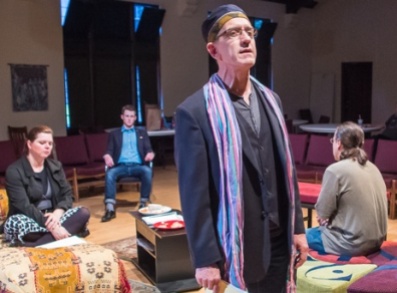
Song of Solomon by Jeffrey W. Hamilton
Solomon. What a guy. Superb lineage, a couple of in-your-face visits from the Almighty, one of which got him everything a man could dream of–literally, and a personal palace twice as big as the Temple. Traditional thinking has him author of a piece of pretty sensual love poetry, over 3000 proverbs and 1000 songs, a few of which we have recorded in scripture, and a memoir of sorts that can only be called the ruminations of a regretful man.
I started a sermon series yesterday about all this, centered in the book of Proverbs, and got reminded again how much this man intrigues me. So he had “700 wives of royal birth”–culturally speaking, it’s hard to imagine just how that works in practical terms, but as one man reminded me after the sermon, it was probably not uncommon for people visiting the king to offer one of their daughters as a gift, which, obviously, kings like Solomon accepted. What’s so fascinating is to climb inside Solomon’s head in his later years, and imagine his reflection over his life.
Proverbs personifies “Wisdom” as a woman. Many call her “Lady Wisdom.” Then there’s the other woman, the adulteress, the prostitute, representing “folly.” Some call her “Dame Folly.” While the ancient Near East was not without other feminine personifications of wisdom, I can’t help but believe that for Solomon, this was pretty personal. I Kings 11 says explicitly that Solomon held fast to these women of his (300 concubines, too) “in love,” and that they turned his heart away from YHWH to the foreign gods of the Sidonians, the Moabites, and the Ammorites. He built places of worship for these gods east of Jerusalem on the Mount of Olives, places that would remain in use until the 7th C. BCE (some 350 years) when Josiah the King finally tore them down. The worship of Ashtoreth meant fertility rites often involving sexual ritual, and Molech and Chemosh demanded human sacrifice. And all within shouting distance of the Temple of God.
How strange. This man had the world at his feet. Kings, princes, and rulers came to him year after year after year, bearing tons (literally) of gifts of the most precious goods of the world. Yet somehow, love bent his heart away from God. When he died, the Kingdom of Israel split in half, and was never the same.
In the first chapter of Proverbs, when we meet Lady Wisdom for the first time, her words are not a soothing wooing of youth. They are harsh, a warning, and she goes so far as to say if she is ignored, she will have no pity when disaster strikes, but will laugh at the whirlwind the foolish create, the storm that destroys. I just wonder if Solomon felt this way in the later part of his life. Did his wisdom tell him that the mistakes he’d made would mean a centuries long whirlwind for his people? I can’t help but believe Solomon knew he’d chosen the wrong lady, and in so choosing, lost both his heart and his kingdom.
Mark Sanford’s dalliance with Dame Folly is nothing new. The wisest man who ever lived couldn’t resist her, either.
Who can?

Fireworks from 2008
Someone asked me yesterday if I remembered the Bi-centennial back in 1976. It was a huge event, and though I don’t remember many specifics, I remember the excitement in the air. I probably went to the big fireworks show out at P.E. Shotwell Stadium in Abilene, Texas, where I was enjoying the summer between my junior and senior years of high school. Or maybe I was working out at Putt-Putt Golf out by the old Westgate Mall, which was my first real job. Or maybe I was out with my girlfriend at the time (very possible). Whatever I was up to, I’m pretty sure I was clueless about anything remotely related to freedom and it’s deeper implications. It’s hard to imagine that on the edges of the Vietnam Era, and with a sister who was passionate about many political issues, I preferred to just wander around reading, thinking, dreaming–all of which were escapes from various difficulties of home and relationship–not very engaged with the broader issues of the time.
I fear I’m still a bit that way. Maybe an era gets in the bones, or your childhood does, and though my sensibilities about the world at large, with its various injustices and inequities, are much more on my radar than they used to be, I confess that I am still not the political animal many are.
But freedom is a big deal. I have no doubt that we take much for granted here. I’ve seen several films lately that underscore what life can be like under explicitly oppressive regimes, regimes that not only abuse the few, but abuse nearly everybody. Seeing Equivocation earlier in the week reminded me that even the best-intentioned governments, politicians, and pundits can destroy lives. It’s easy to pick up a paper and read of crimes against humanity both here and abroad, on personal and national scales. Human trafficking, lack of access to water, the plight of orphans around the world…the list seemingly goes on forever. What do you do? Well, with the connectivity of the internet and the social consciousness of young people driving a new determination to actually battle these issues, thankfully, there’s a lot we can do. On the home front, especially at church, we work on homelessness, increased access to social services like healthcare, job opportunity, hunger relief, and community-building. We’ve got members in Mexico building houses, in Kenya working on AIDS relief and Micro-financing, and soon the teens will be headed to Arizona to work among the poor.
What’s amazing is that we are free to do these things. I guess that’s my only point. There are problems in this culture, surely, but the conversation about those problems flies pretty freely. There are injustices, but at least in great measure, there is energy and room to battle back. Nothing’s perfect, but I’m thankful for the stab at freedom those people took a couple of centuries ago, and I’m thankful for the people who still try to make it work.
Happy 4th…I’m staying home…
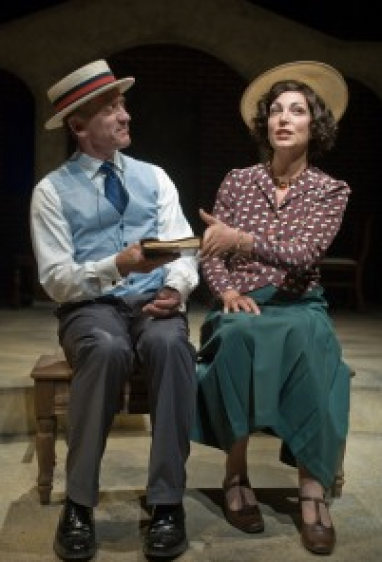
So I’m home from the short journey to Ashland, Oregon. Anjie and I took off Sunday night after the A Cappella time at the Northwest Church, stopped in Portland for the night, and drove another four hours Monday morning, arriving in Ashland just after noon. After a relaxing afternoon and evening just wandering the shops, Tuesday and Wednesday were to be full-on theatre going days. Tuesday it was Macbeth and Much Ado About Nothing, both strong productions, thought there was little in Macbeth even remotely frightening, save the towering sound effects. Peter Macon’s portrayal of the the Scottish King was interesting, and fiery, but for my money, the fire never really came from a real furnace. Robin Goodrin Nordli was tremendous as Lady Macbeth, though, and when I got to the Much Ado performance that night, I noticed that Nordli was understudying Beatrice. I secretly hoped whoever was slated for the role would have the flu so I could watch Nordli again. But no, Robynn Rodriguez went on as schedule (first witch in Macbeth), and while she was fine, after it was over, I was still wishing for Nordli. David Kelly’s Benedick kept me laughing the whole evening, though, so overall, at the end of the first day, I gave the best play of the day nod to Much Ado.
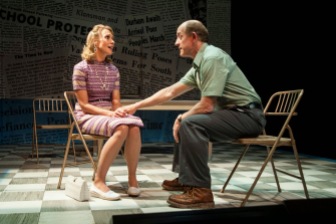
Then came Equivocation.
“The use of equivocal or ambiguous expressions, esp. in order to mislead or hedge; prevarication.” So says dictionary.com. And in short, that’s what the play’s about: the ability to tell the truth (or not) in difficult circumstances. How does a playwright like Will Shagspeare (variant spellings, I guess?) tell the truth about current events relating to a terrorist plot against King James without ending up bankrupt, or worse, shut down?
From the get-go, I was hooked.
I suppose part of it was just the ease of language. After 5 plus hours the day before of listening to the heightened language of the Bard, it was just easy to listen to Bill Cain’s crisp dialogue. But beyond that, these characters were dense and richly drawn, and as we watched “Shag” (Anthony Heald) pursue the truth of the so-called “powder plot”, we agonized with him over how to give the Prime Minister what he wanted. Jonathan Haugen’s portrayal of Robert Cecil, limping Prime Minister who wishes he was king, was absolutely brilliant. By turns loathsome and affecting, Haugen’s force was palpable. The other characters were equally fine, and to listen to the amazing voice of Gregory Linington was particularly satisfying.
Two things and I’ll wrap this up: 1) I loved the theatricality of the piece. The actors slipped between characters effectively and unexpectedly. The stage was sparse, but beautifully designed, it’s open platform and moving props plenty to create the 17th C. world we needed. It challenged me to think again of how to create scenic flow and structure with theatricality and surprise. 2) The questions surrounding truth-telling in politics, in religion, and in art challenged me, compel me to think pretty carefully again about what it means to let your “yes, be yes,” and your “no, be no.” What question is really being asked when the hard questions come? Are you answering the question being asked at face value, or are you searching for the question underneath? It’s worth thinking about.
At the end of the play, the audience stood virtually as one to thank them for the show. One of the few standing O’s in recent memory that made any sense.
And of course, those costumes…oh, those costumes…

Michael Jackson
I was probably 10, or somewhere close, when I first became aware of the Jackson 5. The Osmonds were in there, too. (He Ain’t Heavy, He’s My Brother) The boy singing the lead in the stratosphere was cute as a bug, and had talent forever. I was never a big fan of the moonwalk, maybe because I just couldn’t do it. But as the years rolled on, the cute-as-a-bug kid became an icon, a master of music and show, and it was truly thrilling to watch his work. Thriller was just that, the announcement of a new age in both video and music, and all should have been right with the world with Michael Jackson, King of Pop.
Obviously, it wasn’t.

Farrah Fawcett
Farrah was another story. The women of Charlie’s Angels were beautiful, sexy, fantasies for young adolescent boys, of which I was one. If I’m not mistaken, I still have the iconic poster of Farrah stuck in some box in the garage, pack rat that I am. She was never a real person in my mind, at least not until later years, when her life went south, too, and I became aware of various disturbances in her world. Her beauty wasn’t enough to save her, and to watch it fade in both fact and memory panged me.
I also remember distinctly thinking, way back in the 70’s, that it would be weird when the popular people who were our stars and contemporaries began to die. And it is strange. Michael Jackson was 50. I am 50. 60 is a blink away. We live and breathe by the grace of God. As I deal with people facing life’s various seriousnesses each day, I see so clearly that we are not in control of our lives. We choose, we live, we react, we take action, we love. Leaning against so much that seems to push at us, yet eventually, on the physical side, we just wear out. Maybe its cancer, maybe it’s a heart attack, maybe it’s just living way too long to keep going, but one day, it’s done.
A wonderful woman in our congregation has been waiting to die for almost a year, seems like, a victim of a brain tumor. Just this past week, she was finally released, and we all prayed our thanks to God for his mercy. Yet the whole enterprise begs so many questions. Especially in light of the books I’m reading. One is Thomas R. Kelly’s A Testament of Devotion, and the other is The Evidential Power of Beauty, by Thomas Dubay. Both books testify to Glory, to Beauty that is divine, unfathomable, unending, and beyond comprehension, and that those who are truly alive walk in it’s wake, seeking it always. In the face of mortality and loss, truth, beauty, and goodness keep speaking, keep calling out, keep spreading over the world. Tired hands offering the cup of cold water, weary feet walking alongside the lonely, aching backs picking up yet one more burden on behalf of the other, all of us moving along a path the end of which holds great promise.
Don’t really know how to say what I’m thinking, or trying to think, but after my sermon prep from yesterday, in which I encountered once again the giant questions surrounding the holiness of God, I am in a sort of tired awe. Tonight I lead worship at Celebrate Recovery, then again Sunday morning (alongside a good brother), and then again in a special Sunday night time. And I preach the final sermon is a series about what it might mean to live out the verbs of the Christ. Given mortality, seems fit to keep trying. To live the verbs, I mean.
To feed, to heal, to seek out, to embrace, to call, to train, to discipline, to challenge, to listen, to pause….to love…
After Sunday, Shakespeare…

Pixar's Up
We get excited about Pixar movies at my house. And we often talk about going to see the latest Pixar movie together, but it rarely works out. The release of Up was no exception. We talked about it, suggested times, but in the end, Anjie and Daniel saw it first while I was in Chicago for the Arts Conference, and I don’t think Amy got to see it before she took off for New York last week. Yesterday, I was wandering around on a desperately needed Sabbath, and decided to drive by the new Thornton Creek Regal Cinema complex up the street from me, and I pulled in and saw that Up was scheduled to start in 10 minutes. I thought, why not.
Carl and Ellie. The Spirit of Adventure. A bird of bright plumage, a pack of dogs speaking in odd patterns a la electronic collars, and balloons–enough balloons to lift a house off it’s foundation and sail it around the world to an exact spot that is the locus of dreams. A small adventurer stowaway rendered in pudgy roundness. A poignant death, a book of “Stuff I’m going to do” with so many empty pages, and a decision to chase adventure after all.
I wept a little–want to again as I write this–over the beautiful simplicity of the relationship between Carl and Ellie. So recognizable, these adventures you swear you’re going to have and life happens and things don’t go just that way, and yet, the life that happens is just so gorgeous if you open your eyes. There are always adventures that go untaken because of the adventure you choose. There is no adventure like relationship, none nearly so satisfying, so demanding, so dangerous, and so freeing. And of course, it is the relationship that provides the fuel for the journey Carl takes on behalf of Ellie, the adventure that had the elements we come to expect from adventure–travel, exotic locale, heroes and villains. But in the end, it’s back to relationship, and new friends rescue each other in different ways, the ways in which we all need to be rescued.
As the credits rolled, I thought, how beautiful. Not necessarily my favorite Pixar effort, but a work of art, a work of beauty. Such resonance and poignancy. A simple and quirky road to truth. As all the reviewers are saying, it soars.
Beautiful making, lifted me…
Why is it that when people read my scripts, I am not terribly threatened by their response? I write as much lousy dialogue and description as anybody, and the fact that people point it out to me in the process is fine with me. It’s the nature of the work. It wasn’t really true in the beginning, but I got used to it. Obviously, you have to live it with it if your work is ever going to grow.
But music has been a different thing. I don’t know why, which is why I’m taking a minute to reflect on it. I once wrote a Christmas musical for church that a friend told me later he hated. Well, he didn’t say hated. But he did say that there was nothing in it, save one character, that he liked. The music, he said was derivative (terrible thing to tell a writer, as if the vast majority of things weren’t in some measure derivative–can anyone say Shakespeare? But it hurts our pride. Hah…) I didn’t write anything for over six months. Spun into a pretty deep depression, and to this day, I’d kill the desire to write music if I could. And sad to say, I’ve been more successful at killing that impulse than is probably good.
But I always end up rolling back around to it. Since trombone in the sixth grade and singing “500 miles” in the third, I’ve been doing music. Picked up a guitar as a sophomore in high school and have been bumming around with one ever since. But still, when I trot out a song, it’s one of the most terrifying things I do. Not that I think my music is particularly strong or insightful–I’m pretty sure they’re average, run-of-the-mill kinds of songs. But for some reason, when I think that, or worse, when someone tells me that, I default to the notion that I’m average, run-of-the-mill, or probably worse.
Pride. Drives me nuts.
But it makes me sensitive to all the making we do. Again, the creative urge lived out connects something of our hearts to a material something we offer the world. And inevitably, it means we are parading something of our invisible selves for the world to react to, enjoy, or despise. We trade in “goods” that we make and are making, and that commerce is called relationship. It’s easy to see why acceptance means so much.
I’ll keep making songs here and there. Can’t help it, really. Just like you can’t help making whatever you make. Truth is, God’s called us to it, according to the gifts we have.
Takes faith to keep going.
Keep going….
Hard to say where it comes from. The Greeks thought it came from the gods, from the muses. I suppose I still think it does, from God, from sources of creation and spirit that He oversees and delivers in mystery, in conversation, in idea and image. My son is no doubt being inspired even as we speak, roaming the streets of Paris. My daughter sits on a plane headed for New York, where she will work as an intern in a casting agency, no doubt finding inspiration in the Broadway plays she will see over the next six weeks, not to mention the energy of the city itself. Yesterday, it came for me through a brief conversation with the pastor of a small inner city church in Portland.
I spoke with Ike about A Cappella music. But what he told me about was the kingdom of God, and worship, and what it means to “bring it all.” He told me the story of the young people at his church that worship with such impact and energy (makes me think of the word “furiously”) that they couldn’t keep the projector throwing the lyrics on the wall steady.
To inspire. To breathe into. To borrow breath from. For some reason, I took some breath out of that conversation, and almost imperceptibly, began to move with a quicker step, with a lighter heart, with a more purposeful and hopeful energy. I guess after talking about “taking Kingdom ground” on Sunday, it was great and inspiring to hear from someone so obviously doing just that.
Give breath. Inspire. Take ground. Who knows what life will change…
Read that last sentence however you want…
Two weeks ago, our film group watched an old film that isn’t on anybody’s great list. Equilibrium is a Matrix wanne-be starring Christian Bale who plays a bad-guy turned good guy in a world that’s decided the only answer to war is to get rid of all emotion. Dumb movie, really, but it led us to talking about the role of emotional life in human beings, and what the Bible might have to say about it. I was in Chicago last week, so last night was our first chance to dig into the Bible about all of it. And one of the first comments was regarding something that puzzled me for a long time. The Bible has very little to say about emotional life, at least directly. Now before you take me to task, I know “Jesus wept” and everybody talks about his full humanity and that he laughed a lot and that he had lots of passion, which is emotion (think he was calm while he was throwing the buyers and sellers out of the temple?), but that’s not really what I mean.
We live in a world of romantic notions about emotion. What we “feel” is paramount. And “feeling”…well. “Feel” covers a whole gamut of things from internal sensations that arise out of who knows where to tactile sensations to emotional reactions instinctual, instantaneous, or those that develop over time. “Feel” also includes intuition, and even certain kinds of rational moves. Last night we talked about what Eve felt as she stood pondering the fruit the serpent said wouldn’t kill her after all. Pleasing to the eye, good for food, it would make her wise…hmmm. No Greek-like description of passion, but a rather straight-forward list of things we know elevate heart-rate and respiration. Sounds like she just flat wanted. James says it’s our desire that entices us, and what desire doesn’t have emotional life wrapped up in it. Then we talked about David and Bathesheba, and read II Samuel 11. David’s lust for Bathesheba (and for that matter, her parading in front of the king–albeit from a distance–on a rooftop naked), then his panic over her pregnancy and the resulting madness of his action…lots of emotional life roiling there.
We talked about the centuries old debate about the basic dividedness of human beings. Rational vs. emotional, right brain-left brain, head vs. heart–all of these trying to describe what we all feel (there’s that word again), the conflictedness when there are two things we want, and we must choose, navigating the treacherous water between thinking and feeling, both of which are glorious functions and experiences God gave us. But rivers can quench thirsts and they can drown and break us on rocks, and the power of emotion is a bit the same way.
The Bible treats us as full human beings I think, and the stories are rife with the full gamut of human emotion, if you know how to imagine and read between the lines. And while emotion is not the core of the human, I’m not sure there is a core if emotion is not there.
Just thinking…you’d think that passion would be on the list of the fruit of the Spirit (Galatians 5), but no…
…but self-control is…
I’ve discovered some things about how I go about making the work I make. Reminds of a quote from Art and Fear (which I quote all the time) which simply says that our work is to learn how to work on our work. If nothing else after 50 years, I’m getting hints about what that means.
Part of my job these days is to function as a worship leader, which in practical terms means creating a musical atmosphere that allows people to enter into a state of engaged thought and feeling about the nature of God and His presence in the world. Their world. Our faith is that in this engaged state, God does indeed come and reach out to us in experience, in thought, and in feeling. (Whether His reaching out is primarily mental, physical, or combination is a chief area of debate.) He communicates, heals, listens, convicts…there are any number of verbs to describe the action of God among those of faith during worship (again, when the word is used these days, most often musical worship is what is being described.)
How best to go about such a task? It’s a fascinating question, really. In this post, I’m not as interested in the right answer to that question as I am in reflecting on what my trying to answer the question has taught me about the way I go about making art.
Whenever I walk into a creative situation, I generally come without a clear picture of what I’m after. My sense of direction and vision tends to be more general, more intuitive. It’s not that I don’t know what I want, because when I find it, I know that’s it. But, most often, I see the materials at hand, and begin to explore the various possibilities. If the materials at hand include talents other artists are bringing, I am highly dependent on them for creative input and energy. What this kind of process requires is time. Lots of it. Problem is, in the making of music in the world of worship, time is one thing you just don’t have. If you are leading, players look to you for immediate direction and feedback, given the multiple choices they have about how to approach any one piece of music. Producing 6 (six) 3-4 minute songs in a two-hour rehearsal means you have 20 minutes per song, which is 2-3 times through, with a bit of talk in-between. Woe to you if there are equipment issues, personnel no-shows, or various other breakdowns (which are guaranteed, by the way.) And next week, it will 6 (six) more.
What I’m learning is that my sort of intuitive exploration style of coming at things doesn’t work very well in this arena. It would not be hard for me to spend an hour or more per song, in order to really get to the art of it, to draw out the creative possibilities, to make sure everyone is doing the best work they can, secure in their roles. (And that’s if everyone is there, excited to be doing what they are doing, which is not always the case.) Truth is, it just doesn’t work that way.
I think of my way of working as a bit vagabond-like…the word scavenger comes to mind. Taking what’s at hand, making what beauty seems to be suggesting. For better or worse, that’s at the core of my process, whether I’m writing a book or script or sermon, acting a role, directing a play or video, or creating music for a Sunday. In a whirlwind world of 3-point clarity where “making it stick” is all about draining ambiguity and nuance in order to get the millions to “get it” and get it now–and by the way, what we’re talking about them “getting” is God Himself…well, my process seems a bit out of step.
Back to making…